

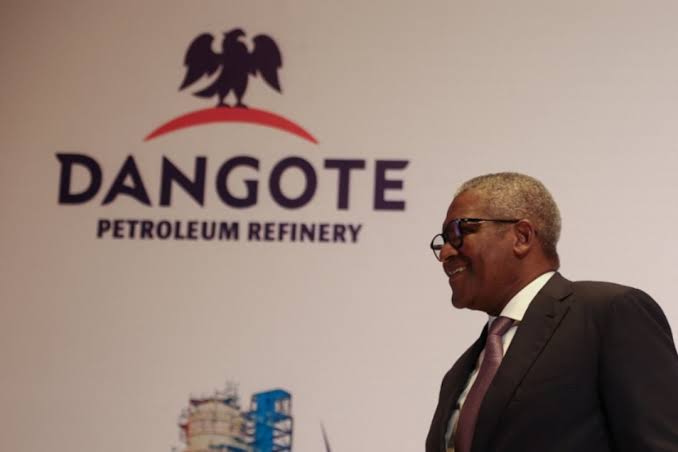
The Dangote Petroleum Refinery has appeared on the digital billboards of New York’s Times Square, placing one of Africa’s largest industrial projects before a global audience as the Nigerian company continues its push to expand ownership and investment in the business. The display was unveiled on September 18th 2026 while the refinery’s initial public offering was underway in Nigeria.
The Times Square appearance carries significance beyond its visibility. Built in Lagos, the refinery has become a major example of large-scale African industrial investment, with Reuters reporting that it is processing about 700,000 barrels of crude a day and is seeking additional capital to expand its capacity. The company’s IPO is Africa’s largest to date and is intended to broaden Nigerian public ownership of the refinery.
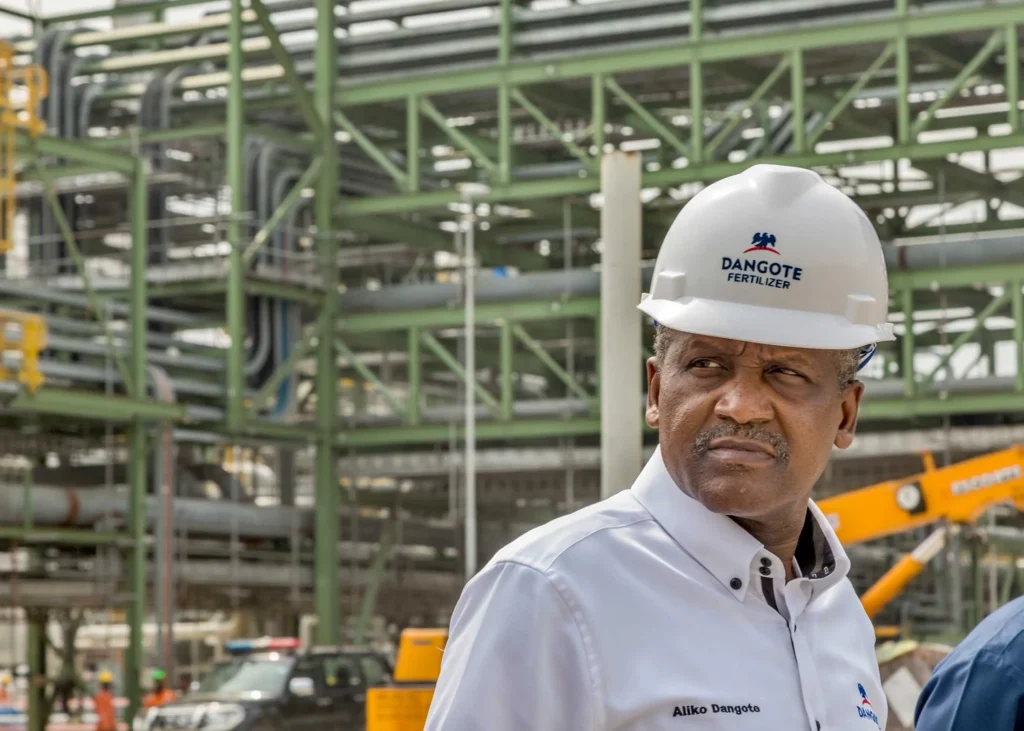
Aliko Dangote touring his refinery in Nigeria
The timing of the campaign also highlights a broader shift in how African businesses are positioning themselves in global markets. Rather than presenting Africa primarily as a destination for external investment and raw-material extraction, large African companies are increasingly seeking to build manufacturing capacity, control more of their supply chains and access international markets from bases on the continent. The Global Africa Business Initiative has similarly identified African businesses moving into higher-value manufacturing, technology, logistics and cross-border services as part of a changing economic landscape.
For African communities, the economic importance of such developments lies in ownership as much as visibility. Large industrial enterprises can create demand for engineers, technicians, logistics workers, suppliers and professional services, while stronger African-owned businesses can create opportunities for local investment and entrepreneurial participation. The Dangote refinery’s IPO adds another dimension by seeking to bring ordinary Nigerians into the ownership structure, with Reuters reporting a minimum purchase of about US$4 and a stated ambition to reach millions of retail investors.

The message accompanying the Times Square display, “Made in Nigeria. Built for the world,” reflects that outward-looking approach. The post describing the moment also argued that “Africa is not just participating in the global economy. Africa is building, owning, and shaping it.” While that is an evaluative statement from the author rather than an independent measurement, the refinery’s scale, international sales and attempt to widen ownership provide concrete examples of an African enterprise operating within global markets.
For African entrepreneurs and professionals in Australia, the example also has relevance. African diaspora communities maintain business, investment and professional connections across continents, and the growth of African-owned enterprises creates potential pathways for partnerships, skills exchange, investment and market access. Developing those links can help move diaspora economic activity beyond individual remittances towards business relationships, investment and participation in expanding African industries.
The Times Square display therefore represents more than an advertisement for one Nigerian company. It comes at a moment when African businesses are seeking greater access to capital, wider ownership and stronger positions in international markets. The challenge for African economies and communities is to ensure that this growing industrial ambition translates into broad-based opportunities—through jobs, enterprise, investment and skills development—so that African economic success is increasingly measured not only by companies reaching global markets, but by how widely the resulting opportunities are shared.
For African entrepreneurs and professionals in Australia, the example also has relevance. African diaspora communities maintain business, investment and professional connections across continents, and the growth of African-owned enterprises creates potential pathways for partnerships, skills exchange, investment and market access. Developing those links can help move diaspora economic activity beyond individual remittances towards business relationships, investment and participation in expanding African industries.
The Times Square display therefore represents more than an advertisement for one Nigerian company. It comes at a moment when African businesses are seeking greater access to capital, wider ownership and stronger positions in international markets. The challenge for African economies and communities is to ensure that this growing industrial ambition translates into broad-based opportunities—through jobs, enterprise, investment and skills development—so that African economic success is increasingly measured not only by companies reaching global markets, but by how widely the resulting opportunities are shared.
The Dangote Refinery IPO carries a weight that goes beyond the staggering numbers on its prospectus. For African-Australian professionals and entrepreneurs, the most important signal is that the continent’s largest economy is now actively courting its diaspora as investors, not just remitters. The entry price of roughly $4 AUD for ten shares is designed to build a “people’s IPO” base, targeting millions of shareholders across Africa and beyond. This is a direct invitation for those who left the continent to build wealth in Australia to now also hold a stake in the infrastructure driving Africa’s industrial future, rather than keeping their capital strictly in Australian assets.
The deeper lesson here is about the shifting infrastructure of access. Historically, investing back home from Australia meant navigating opaque brokers, prohibitive minimums, and unreliable settlement mechanisms. That is changing rapidly. Digital platforms and fintechs are now explicitly building the plumbing for diaspora capital, with Nigerian exchange leadership acknowledging the diaspora as a key constituency for market growth. Partnerships are emerging to make Nigerian securities accessible remotely, addressing the old barriers of information asymmetry and cross-border onboarding. For African-Australian professionals, the barrier to entry is no longer about will or capital—it is increasingly just about understanding the new digital rails.
The strategic lesson from Dangote’s journey is the power of vertical integration and long-term conviction, applied on a continental scale. Dangote started as a trader, learned the market, and then systematically moved up the value chain into manufacturing cement, sugar, and now refining petroleum—building and owning the critical industrial infrastructure others relied on. For African-Australian entrepreneurs, this is a template. The Australian market offers stability and access to capital, but the African opportunity lies in building the systems that fuel the continent’s next decade of growth. The question is whether they position themselves as traders of their skills in Australia, or as owners of the infrastructure in Africa.
