

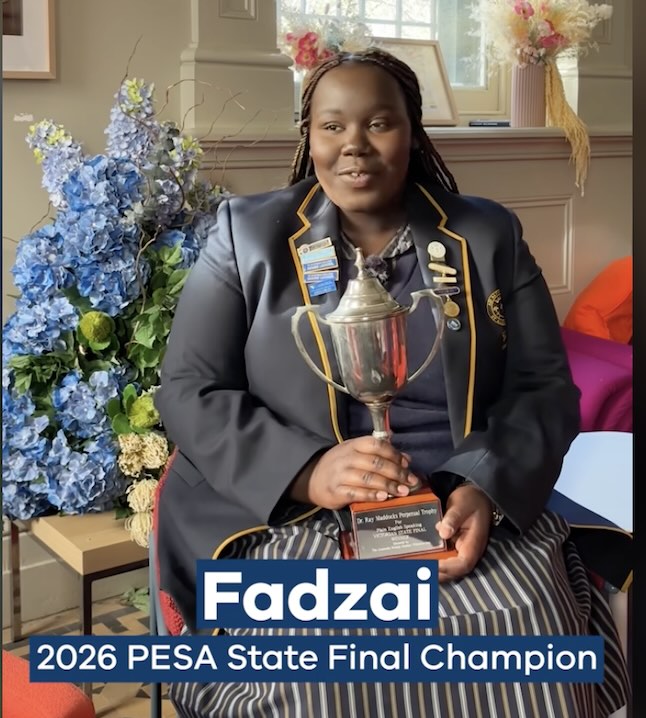
When Fadzai Bako stepped onto the stage at the 2026 Plain English Speaking Award (PESA) State Final, she carried more than a prepared speech. She carried the weight of a community too often talked about, rather than listened to.
By the end of the night, the St Aloysius College, North Melbourne student had claimed the championship — becoming the first back-to-back winner in PESA’s nearly 50-year history.
Her speech, What colour is the headline?, explored the corrosive impacts of negative media representation on African Australian youth. It was a topic she knew intimately. And her victory was a live demonstration of the very argument she made: when African Australian young people are given the right environment, support and a fair chance to compete, they do not merely keep up. They lead.
The PESA State Final brought together six of Victoria’s most accomplished young orators. They tackled deepfakes, the human cost behind AI and girls’ rights to education in Afghanistan. Runner-up Elle Damiandis from Huntingtower School delivered a compelling speech on The human cost behind your AI prompt, examining the mental harm inflicted on workers in Kenya who sort and label images to train AI. The standard was extraordinary.
But Fadzai’s win was historic. She first competed as a Year 10 student in 2024, won the Award in 2025, and defended her title in 2026. In an award that has run for nearly half a century, no one had ever done that before. It is not just a testament to her skill. It is evidence of what sustained investment in young people can produce.
PESA is a public-speaking competition for high school students, celebrating innovative thinking, research and effective, direct communication. It encourages participation from government, Catholic and independent schools and gives students the chance to build self-confidence and extend their skills in oral communication, speech writing and research. In other words, it offers exactly what so many young people need: a platform, a standard and a fair shot.

Contact AMA today and be part of a great team of story tellers and media influencers
Fadzai spoke about why that matters.
“PESA is so meaningful to me,” she reflected. “A lot of people don’t get the chance to speak up. So, myself with a voice, a really loud one, can stand up and tell people what’s on my heart – I think PESA is a great way to do that.”
That quote captures both the opportunity and the gap. Fadzai has a loud voice. But how many other African Australian young people have equally powerful things to say, and no stage on which to say them? How many are in schools without robust public speaking programs, or communities without mentors who can help them shape an argument, research a topic and deliver it with confidence?
The talent is not missing. The opportunity often is.
Fadzai’s speech on negative media representation is especially significant. For years, African Australian youth have too often been reduced to headlines — framed through crime, disadvantage or deficit. That framing has real consequences. It shapes how teachers, employers, police and politicians see young people. It can shape how young people see themselves. Fadzai took that narrative and turned it into a championship-winning argument. Then she won the championship. It is hard to imagine a more eloquent rebuttal.

Her success should not be treated as an exception that proves the rule. It should be treated as a signal of what is possible when African Australian communities are resourced, trusted and included. That means supporting community-led programs, ensuring equitable access to competitions like PESA, and creating environments in schools and beyond where young people are encouraged to speak, not silenced.
Runner-up Elle’s speech also reminded the audience that young people are thinking globally, connecting local issues to international labour exploitation and technology. Victoria’s young orators are ready for complex conversations. The question is whether adults are ready to give them the microphone.
Congratulations are due to all the participants in this year’s competition. But Fadzai Bako’s historic win deserves more than applause. It deserves attention. It is a reminder that African Australian youth are not short on talent, ambition or ideas. When given the right environment and a fair competition, they will stand up, speak up — and make history.
