

For African women professionals, employment is about more than earning a living. It can also be a source of recognition and validation. Yet the mental, emotional and professional toll of navigating the workplace often goes unacknowledged.
Some women come to Australia with education qualifications from their countries of origins which need to be converted, but for some these, qualifications are not recognised.
Some of my older sisters arrived with dreams and aspirations following established careers in law and medicine prior to coming to Australia which have sadly not been recognised following their arrival in Australia. They’ve had to restart their careers and forced to change professions in some cases. For some this has been a disempowering process, for others it has given them the opportunity to explore other avenues previously not available to them.
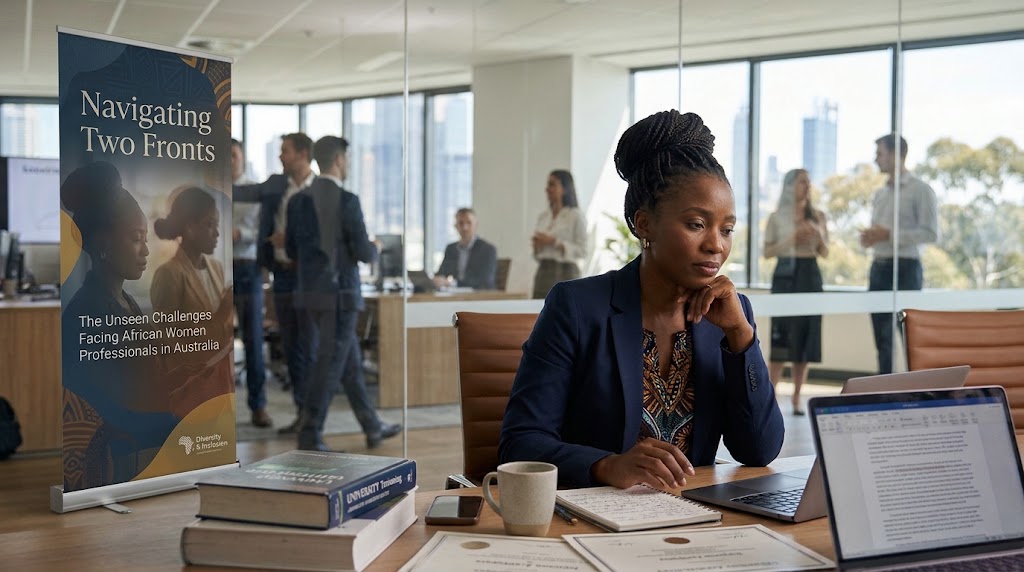
African -Australian women face challenges for their educational and professional goals
Starting again is not simply a matter of enrolling in another course or finding a different job. It can mean rebuilding a professional identity that took years to establish. The cost of further study, the time needed to retrain and the demands of supporting a family can make that transition difficult. There is also grief in leaving behind work that once brought purpose and worth. New opportunities may emerge, but acknowledging those possibilities should not erase the loss or diminish the expertise women bring with them.
Navigating Gender and Cultural Barriers
African women professionals in Australia often navigate two fronts: the structural barriers of a historically male-dominated workplace and the pressure to code-switch in environments where their cultural identity, name or accent may be viewed as a deficit rather than an asset.
Managing multiple identities to fit in at work can contribute to emotional exhaustion and professional fatigue. At the same time, qualifications and strong engagement do not necessarily translate into access to leadership opportunities.

Belonging should not require a woman to leave parts of herself at the door. When fitting in means constantly monitoring how she speaks or how her confidence might be interpreted, work can demand more than the role itself. This raises an important question: are workplaces welcoming difference, or merely expecting people to adapt to existing norms? Meaningful inclusion requires more than recruitment. It calls for fair access to mentoring, recognition of diverse experience and pathways to progression that do not depend on cultural familiarity.
The Pressure to Prove Yourself
For African women who feel overlooked or underestimated, meeting expectations can seem insufficient. The pressure to continually exceed them—and pursue additional qualifications—can become a way of seeking recognition and countering assumptions about their abilities.
I can attest to this. When I got to university I was undertaking a double degree with multiple streams, pursuing one degree was insufficient. The pursuit to be highly educated as never ended, I went on to complete my master’s in business administration, in addition to numerous other qualifications as I was progressing through my career. I had the need to be seen, you must be outstanding to stand out.
When Qualifications Become a Barrier
Yet this pursuit can become a double-edged sword. Some African women describe missing out on jobs because they are considered overqualified. They are left navigating a difficult balance: gaining the credentials needed to be taken seriously without having those same credentials used as a reason to exclude them.
There is a difference between learning out of curiosity and pursuit for knowledge and expertise and learning because you feel you must continually prove your worth. Education can be empowering, but it should not become an endless test of whether someone deserves a place. The responsibility cannot rest solely with women to acquire another credential or work harder. Employers also need to examine how they recognise potential and assess suitability, so that ambition is supported rather than turned into another obstacle.
