

By Clyde Sharady | Editor

I have read the recently published South Sudanese Australian Youth Justice Expert Working Group report with real respect. It is serious, community-grounded work delivered thanks to the leadership of Dr Santino Deng in Melbourne Victoria.. It listens. It names the drivers of over-representation. It refuses to blame the community. And it repeatedly says the right thing: solutions must be community-led.
However, the I read it as someone who has worked in and around effective community leadership, I am left with a clear concern. The report speaks often and warmly about community leadership. It does not speak enough about it in operational terms. That is the gap I want to name—not to diminish the report, but because implementation will expose it.
The report gets the principle right. It lists strong community leadership and eldership as a community strength. The Chair’s foreword praises the community’s leadership and calls for genuine partnership. The proposed community hub is described as a trusted, community-led model. Youth leadership and youth-led programs are recognised as protective factors. There is a community implementation committee and a call for ongoing community involvement in decision-making, monitoring and accountability. All of that is important. It signals the right posture. But a posture is not a structure. A principle is not a plan.
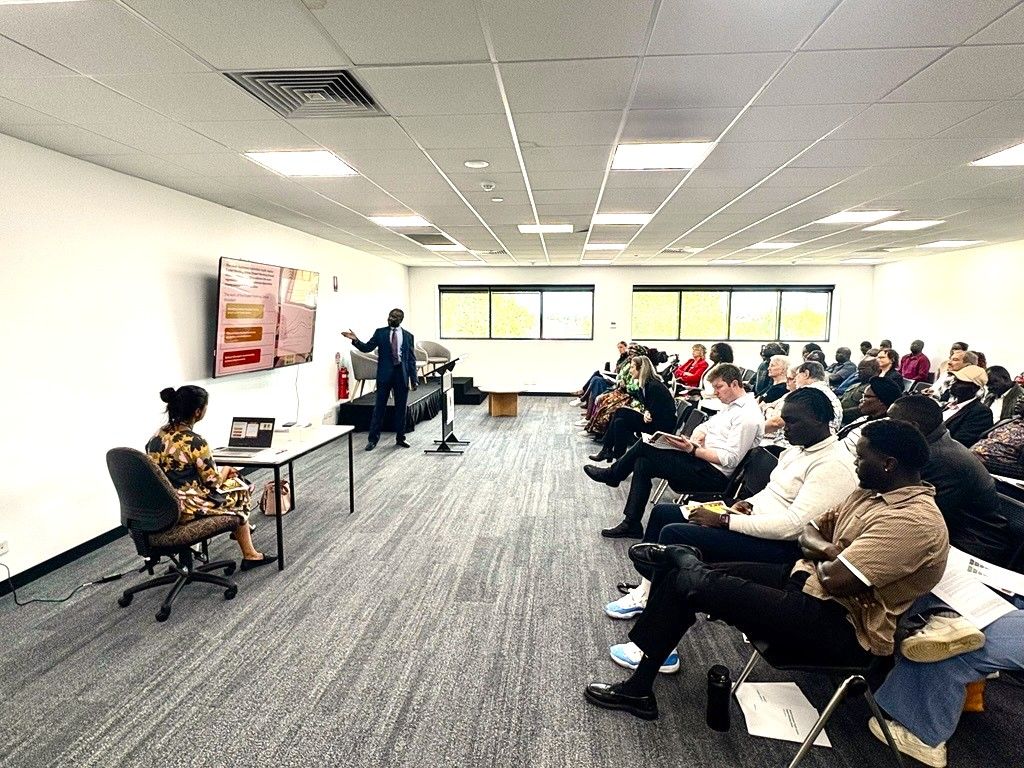
Dr Santino Deng presenting the report to the community
In my experience, effective community leadership is not created by using the phrase “community-led.” It is created by answering hard questions about authority, money, governance, capability and accountability. On these questions, the report is largely silent. There is no dedicated recommendation or strategy for developing, resourcing and sustaining community leadership. There is little on leadership pipelines, governance training, succession planning, Elders’ councils, faith-leader engagement, or paid community leadership roles.
The report acknowledges Elders and faith leaders, but does not match that acknowledgment with specific actions. “Community-led” is used frequently, but it is not clearly defined. Who leads? With what decision-making authority? How is funding controlled? How are disagreements between community leaders and government resolved? How is representation handled in a diverse community that includes different clans, faiths, generations and experiences? These are not technical afterthoughts. They are the difference between partnership and consultation.
If we are serious about community leadership, the report should force government and community to answer some hard questions. When a program is called community-led, does the community hold real decision rights over design, budget and staffing—or is it asked to endorse decisions made elsewhere? Are community organisations funded for core governance and leadership capacity, or only for delivering programs? You cannot lead from a project grant. What is the role of the community implementation committee? Is it advisory, or does it have power? Who appoints it, and to whom is it accountable? Where are the leadership pathways for young people, women, Elders and faith leaders? Where is the succession planning so that leadership does not depend on a few exhausted individuals? How does the process ensure that community leadership does not become the voice of the loudest or most connected few?
Government is asked to be accountable to community—what are the community’s own accountability mechanisms, and who supports them to build those mechanisms? And what happens when there is disagreement? Genuine partnership assumes conflict. What is the dispute-resolution architecture when community and government do not agree? These questions are not hostile. They are the questions anyone with experience in community leadership asks before signing up to a partnership.

The risk is predictable. Without operational clarity, community-led becomes a label. Community leaders are invited to meetings, asked for input, and then asked to support decisions they did not shape. Funding goes to programs, not to the governance capacity needed to run them. Burnout increases. Trust erodes. And when delivery falters, the same community leaders are blamed for not being ready. That is not a failure of community leadership. It is a failure to design for it.
The report’s implementation architecture—a senior leader, a community implementation committee, public progress reporting, a monitoring and evaluation framework—is a good start. But the report does not say how much decision-making power the community committee will have, how it will be resourced, or how community leadership will be strengthened rather than simply consulted.
What I would want to see next is a dedicated community leadership strategy, co-designed with the community. It would need a clear definition of community-led with agreed decision rights, core funding for community governance and leadership capacity, leadership development and succession planning across generations including young people, women, Elders and faith leaders, a transparent process for community representation and accountability, paid community leadership and liaison roles, and a two-way accountability framework between government and community.
This report is good work. It says the right things about community leadership. But saying the right things is not the same as building the architecture that makes them true. The test of this report will not be whether it uses the phrase community-led. The test will be whether community leaders have real authority, real resources and real accountability—not just a seat at the table, but a share of the power to set the table. Until the report answers those operational questions, its commitment to community leadership remains a promise. And our community has waited long enough for promises.
