

3 minutes read – By Clyde Sharady
Australia is talking increasingly seriously about Africa.
The conversation is no longer limited to diplomacy or development programs. Africa is now being discussed in the context of trade diversification, critical minerals, mining technology, agriculture, education, renewable energy, infrastructure and investment.
That is a good thing.
Australia has considerable expertise that African countries need, while Africa represents some of the world’s fastest-growing markets and offers opportunities far beyond the traditional mining conversation. In June 2025, Australia signed a Memorandum of Understanding with the African Continental Free Trade Area Secretariat aimed at promoting trade, investment and business partnerships. The Australian Government noted that more than half a million people in Australia have family links to Africa and that two-way goods and services trade with Africa was worth more than $12 billion in 2024.
Australia is clearly interested.
But there is a question that needs to be asked more openly:
Where are the Africans in this conversation?
A recent roundtable held in Melbourne provides an interesting example.
The event was was co-hosted by Australia Industry Group and Australia Africa Chamber of Commerce and it was convened bv the Australian Trade and Investment Commission (Austrade) . This business roundtable brought together Australian government and trade representatives with business and industry leaders from areas including mining, agriculture, tourism, water, higher education, employment and small business.
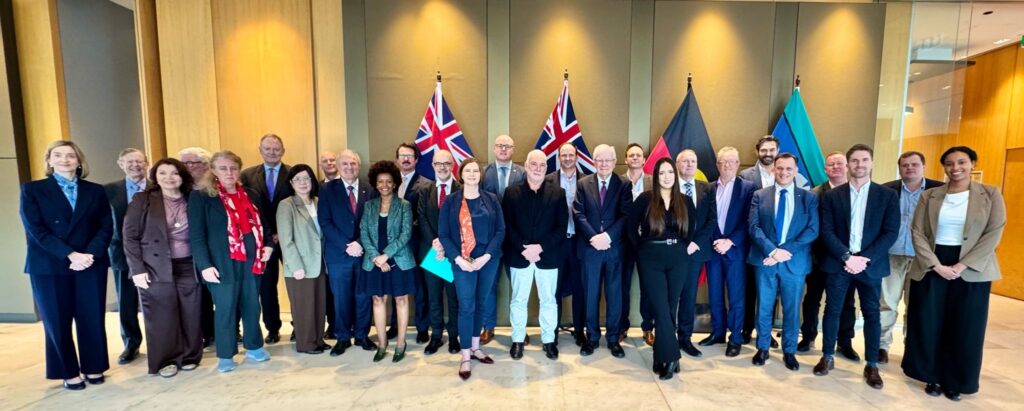
Participants at the Strategic Australia-Africa Trade and Investment Roundtable in Melbourne in late September 2026.
On paper, this is exactly the kind of conversation Australia needs. Yet for many people from African communities looking at the event from the outside, something was striking: there appeared to be very few, if any, visible Black African faces among the participants.
That raises a much bigger issue than the composition of one meeting.. It raises questions about who is shaping Australia’s Africa strategy, who is being invited into the conversation and whether Australia is making sufficient use of the African expertise already available inside this country.
This is not an argument that Australians cannot represent Australian interests in Africa. They can. Nor is it an argument that Africa should only be represented by people of African descent. That would make little sense.
Australia has developed genuine expertise in Africa, particularly through its resources sector. More than 170 ASX-listed companies operate across 35 African countries, according to DFAT, while Austrade is actively promoting opportunities for Australian mining equipment, technology and services companies across African markets.
The expertise is real. The opportunity is real. But so is the opportunity to bring another group into the room: African Australians. There are Africans living in Australia who understand both sides of this equation. They may have grown up in Africa, worked there, maintained business relationships there or speak the languages of the markets Australia wants to enter. At the same time, they may have Australian qualifications, business experience and an understanding of how Australian government, corporations and institutions operate.
That combination is potentially extremely valuable. Yet it is not always being used strategically.

From representation to participation
There have been criticisms within parts of the African community that some existing Africa-focused business structures in Australia do not adequately reflect the diversity of the African continent or the African diaspora living here.
Those criticisms should not automatically be treated as proven allegations against particular individuals or organisations. But they do raise a legitimate question: Is Australia’s Africa business ecosystem sufficiently broad?
Africa is not one country. It is a continent of 54 countries with different languages, economic systems, political structures, cultures and business environments. So any organisation seeking to facilitate trade with Africa should reasonably ask:
Who is in its network? Which African markets does it understand? Which African business communities does it regularly engage?How many African entrepreneurs are members? How many are involved in leadership, advisory structures, trade missions and business-matching activities? And how many African Australians are actually helping shape the agenda?
These are not unreasonable questions. The objective should not simply be to organise more Africa-related events. It should be to build more Africa-related business.
That requires people who understand the markets. Austrade already has an Africa-focused Trade and Investment Commissioner and is actively supporting Australian businesses seeking international opportunities. The question is therefore not whether Australia is doing anything in Africa. It clearly is.
The question is whether there is enough deliberate engagement with the African entrepreneurial community in Australia to create a new generation of Australia–Africa business leaders.

Buy your copy of this wonderful book today
African Australians are an economic asset
Instead of simply inviting African entrepreneurs to attend conferences, Australia could invest in developing them. Imagine a structured program that identifies African Australian entrepreneurs with credible businesses and helps them become Australia–Africa commercial connectors.
Give them access to market intelligence. Introduce them to Australian exporters.
Connect them with mining technology companies, agricultural businesses, universities, financial institutions and professional services firms. Take them on carefully selected trade missions. Help them understand international contracting, procurement, compliance, export finance and government processes and at the same time, connect them with credible businesses and institutions across African markets.
The result could be a new generation of African Australian business leaders capable of building trust across two business cultures.
Consider for example the mining industry as an example. Australia has a long history of mining involvement in Africa and has developed a deep ecosystem of mining companies, exploration firms, drilling contractors, engineering firms and Mining Equipment, Technology and Services (METS) providers with experience relevant to the the continent.”
As the US seeks to loosen China’s grip on critical mineral supply, it is investing heavily in mineral-rich countries like DR Congo, Nigeria and Zambia. As money flows in, more investors could follow if the African diaspora were empowered to facilitate Australian investment in Africa, so Australia’s technology, finance and expertise can create more wealth across both continents. Mining also offers non-mining opportunities—energy, agriculture/food and technology—where many Africans have expertise to leverage. More Australian companies might go to Africa but are held back by somewhat distorted risk perceptions. Greater diaspora involvement can help them manage risks and thrive where Chinese, Asian and increasingly American companies already do business.
That is not diversity for diversity’s sake. It is commercial infrastructure.
African Australians need to be viewed beyond a community or cultural lens. They are engineers, lawyers, doctors, accountants, entrepreneurs, investors, academics, technology specialists, exporters, importers, property developers, consultants, farmers and business owners.
Many have professional networks extending well beyond Australia. Some have relationships in several African countries. Some can reach people who may be difficult for a newcomer to access. That is an economic asset. Australia should be asking how to unlock it.
But African communities also need to look in the mirror.
It is easy to complain that Australian institutions are not engaging enough with African entrepreneurs. The harder question is whether African entrepreneurs are doing enough to make themselves part of the mainstream Australian business conversation.
Are they attending industry conferences? Are they joining chambers? Are they forming sector-based professional networks?
Are they approaching Australian corporations? Are they learning how government procurement works?Are they developing businesses capable of operating internationally?
Are they presenting themselves as serious commercial partners rather than simply asking to be included because they are African?
There is work to be done on both sides.
Institutions must open the doors. African professionals and entrepreneurs must walk through them — and bring something substantial to the table.
Beyond mining
This opportunity is also much bigger than mining.
Australia’s cooperation with the AfCFTA identifies areas including financial services, medical and pharmaceutical research, education, agriculture, mining and mineral processing, renewable energy and small and medium-sized enterprises. It also recognises the importance of direct contacts between African and Australian entrepreneurs.
Consider what that could look like.
An Australian agricultural technology company looking at Africa could work with an African Australian entrepreneur who understands farming conditions and commercial relationships in several African countries.
An Australian mining technology company could partner with African Australian engineers or businesspeople who understand the operational environment. An Australian university could work with African Australian academics to establish deeper partnerships with African institutions.
An Australian technology company could enter African markets through entrepreneurs who understand local consumer behaviour and business culture. An African company looking to invest in Australia could similarly use the African Australian community as a bridge into the Australian economy. This is how relationships become commercial.
Not through photographs. Not through panels. Not through having one African speaker on a stage.
But through sustained relationships that produce contracts, investments, partnerships, jobs and new businesses. That is why the distinction between representation and participation matters.
Representation says: “We have an African here.”
Participation says: “This person has a role in shaping what we are doing.”
Australia needs more of the second.
A two-way responsibility
The Melbourne roundtable should therefore be seen as an opportunity for reflection rather than simply criticism.
Australian institutions can ask: if Australia is serious about building a long-term strategic relationship with Africa, are the people who understand Africa best sufficiently involved in building it?
African communities can ask an equally important question:
If we want to be part of Australia’s Africa strategy, are we organised and prepared enough to take our place at the table?
Neither side can build this relationship alone. Government has a role.
Austrade has a role. Business chambers have a role.
Australian corporations have a role. African diplomatic missions have a role. Universities have a role. African professional networks have a role. And African entrepreneurs have a role.
Perhaps Australia needs a deliberate Australia–Africa entrepreneurial bridge — a network that identifies African Australian business talent and systematically connects it with Australian companies seeking opportunities across Africa.
Such an initiative could include mentoring, market intelligence, trade missions, business matching, investment readiness, export training and connections with African business networks. It could also deliberately target young entrepreneurs and women in business.
This would not necessarily compete with existing institutions. It could make them stronger. Australia is already strengthening its engagement with Africa through ministerial visits, Australia–Africa Week, mining forums and other initiatives. Its cooperation with the AfCFTA and the growing parliamentary discussion about Australia–Africa trade and investment demonstrate that the policy conversation is happening.
The next challenge is making sure the business community reflects the relationship Australia says it wants to build. If Africa is going to become a serious strategic partner, Africans cannot remain spectators to the conversation. And African Australians cannot wait indefinitely for someone to invite them. They need to organise, participate, build credible businesses and make themselves impossible to overlook.
At the same time, Australian institutions need to move beyond the occasional invitation and create genuine pathways for African participation. That means bringing African entrepreneurs into the planning room. It means inviting them into trade delegations. It means listening to their market intelligence. It means connecting them with Australian businesses.
And it means recognising that African Australians are not simply a demographic group. They can be a strategic economic asset.
The Melbourne event therefore leaves us with a question that is uncomfortable but necessary:
If Australia is serious about Africa, where are the Africans?
Not just at the next photograph. Not just on the next panel. Not just when cultural representation is required.
But in the boardroom. In the business delegation.
In the trade mission. In the investment discussion. In the policy consultation.
And in the room where Australia’s long-term Africa strategy is being shaped.
Australia has an opportunity to build something much bigger than another series of Africa-focused events.
It can build a genuine economic bridge between two continents.
But bridges require connection from both sides.
The Australian side needs to open the door wider.
The African side needs to step forward with confidence, capability and serious business propositions.
If both sides do that, the question of where the Africans are will eventually have a very different answer:
They will be at the table — helping to build the partnership, rather than simply being invited to witness it.
