

Burkina Faso has inaugurated its first national gold refinery, marking a new stage in the country’s efforts to process more of its mineral resources domestically. The RAFFINOR-BF facility in Ouagadougou was officially opened on September 28th 2026, after construction began in November 2023. The refinery has an initial annual refining capacity of 164 tonnes, with plans to expand that capacity to 515 tonnes in a later phase.
The facility comes as gold remains central to Burkina Faso’s economy. The country produced more than 94 tonnes of gold in 2025, according to figures released by the Ministry of Energy, Mines and Quarries, while the US Geological Survey notes that gold accounted for more than three-quarters of Burkina Faso’s total export value in 2023. The new refinery is intended to shift a greater part of the value chain—from extraction through refining—into the country rather than sending raw or semi-processed material abroad.
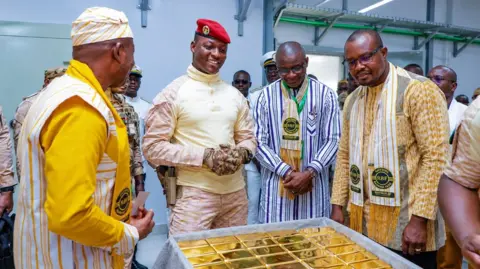
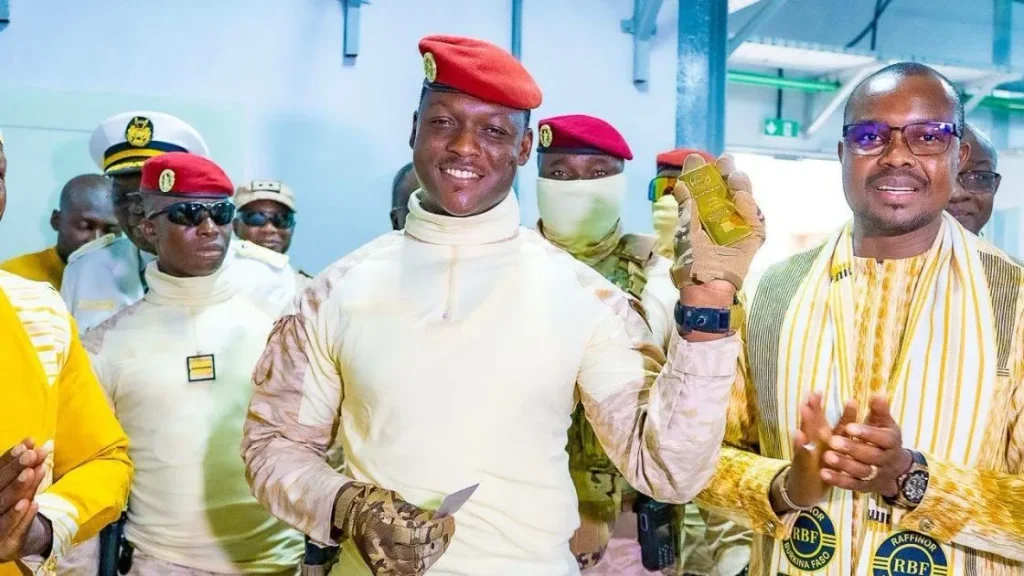
President Ibrahim Traore inaugurates the new refinery
The refinery occupies five hectares and includes a foundry, analytical laboratory, gold storage facilities, jewellery production space and administrative buildings. According to Burkina Faso’s mining ministry, the first phase uses modern, automated equipment and is designed to allow additional refining lines to be added as demand and production increase. The government has described the facility as part of a broader strategy to increase domestic value addition in the mining sector.
For workers and businesses, the significance of the project extends beyond the production of gold bars. Domestic refining can create opportunities in laboratory services, engineering, equipment maintenance, transportation, security, jewellery manufacturing and other supporting industries. It also creates a platform for technical skills to develop around activities that previously took place outside the country. The stated objective is to ensure that a larger share of the economic activity generated by gold remains within Burkina Faso.
The refinery is also part of a wider series of changes in Burkina Faso’s approach to mining. The 2024 mining law increased the state’s free-carried interest in mining operations to 15%, according to the US Geological Survey, while the government has subsequently taken control of some industrial mining assets through the state-owned Société de Participation Minière du Burkina Faso. Authorities have said the reforms are intended to increase national participation and government revenue from mineral production.
Burkina Faso has meanwhile expanded domestic processing beyond the new refinery. In January 2024, the country launched its first industrial facility dedicated to treating mining residues, Golden Hand SA, in Ouagadougou. Later that year, the government received 93.197 kilograms of gold recovered from more than 440 tonnes of mining residues processed by the company using technology developed by Burkinabè engineers. The development demonstrated how value can also be recovered from materials that had previously been treated outside the country.
The opening of RAFFINOR-BF therefore represents a shift from simply extracting gold towards retaining more stages of its production inside Burkina Faso. The source material describes the broader objective as “forging self-determining economies and seizing control of their mineral resources, including the refining and production processes.” Whether the new model ultimately delivers greater employment, public revenue and industrial development will depend on the refinery’s capacity utilisation, the sustainability of mining production and the government’s ability to connect mineral wealth to wider economic opportunities for citizens.
Alex Nyembo | AMA contributor
