

A quiet moment on the weekend at Ballarat Swans produced a headline performance that says much more than the scoreboard suggests. Former AFL player Bigoa Nyuon, affectionately known as “Waaahhhh” within his business family, delivered a standout nine-goal display—an unusual feat for a player whose journey already stretches far beyond football alone.
The performance, described internally as “just the lazy nine big ones,” reflects not only athletic ability but also a broader narrative: the evolving identity of elite athletes after professional sport.
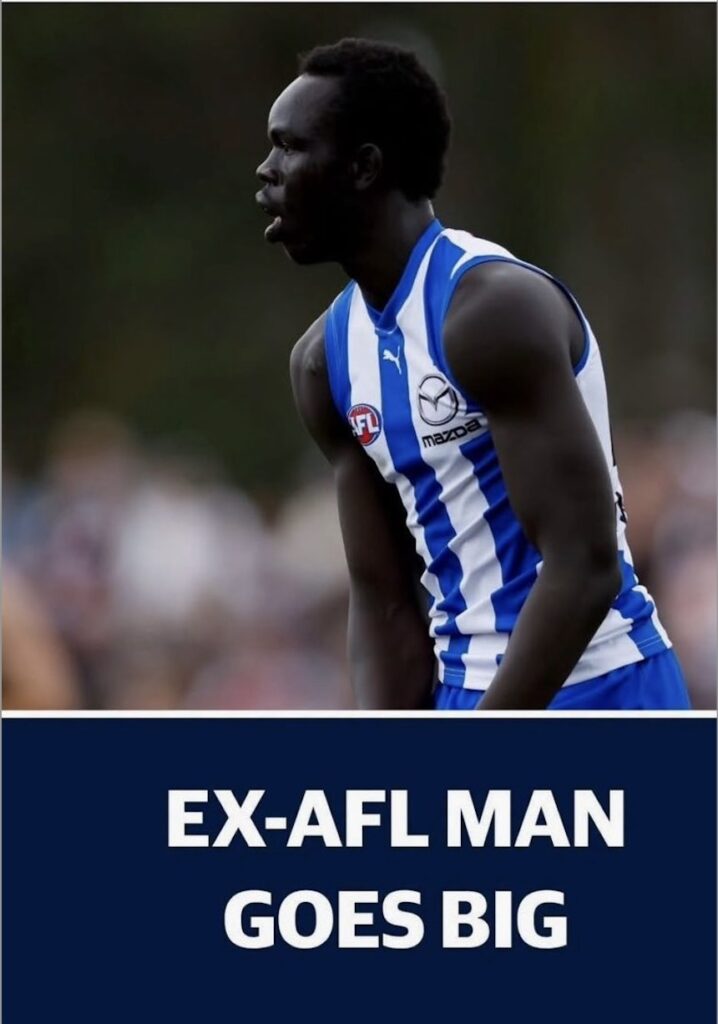
A Transition Beyond AFL
Nyuon’s path mirrors a growing trend seen across professional sport globally—athletes successfully transitioning into business, corporate leadership, and community enterprise after elite competition.
Once part of the elite Australian Football League system, where he represented clubs including Richmond and North Melbourne, Nyuon’s AFL journey placed him among a small percentage of athletes who reach the highest level of Australian rules football. Like many AFL players, his time in the system involved intense physical demands, relocation, and the constant pressure of performance and selection.
However, research into athlete transition in Australia shows that retirement or delisting from elite sport is often a major identity shift. Studies by organisations such as the Australian Institute of Sport (AIS) highlight that athletes who successfully transition tend to build strong second-career pathways early, particularly in leadership, education, or business environments.
Nyuon appears to be a case in point.

Bigger Nyuon with his business colleagues (Photo source : Linked in)
From Professional Sport to Professional Services
Over the past two years, Nyuon has transitioned into a specialist role within a local strata insurance business , building a profile in a sector far removed from the football oval but requiring similar discipline, teamwork, and strategic thinking.
Within the organisation, colleagues describe his transformation as seamless—moving from professional athlete to a high-performing contributor in strata insurance services, a field that supports property owners and communities in managing complex insurance needs.
His recent on-field performance for the Ballarat Swans has only reinforced his reputation for excellence, showing that the competitive edge developed in elite sport often translates into other arenas.
More Than a Game: The Role Model Effect
The importance of athletes like Nyuon extends beyond sport and business. Across Australia, AFL players—particularly those from diverse and migrant backgrounds—are increasingly seen as powerful role models in multicultural communities.
Academic research from Australian universities, including the University of Melbourne and Victoria University, has repeatedly shown that visible success stories in sport help strengthen youth aspiration, belonging, and identity. Athletes from African and migrant backgrounds in particular often carry dual influence: they represent excellence in sport while also demonstrating pathways into education, employment, and leadership.
This dual impact is significant in communities where representation in mainstream professions is still emerging.
Community Impact Through Visibility
Stories like Nyuon’s also contribute to a broader narrative of inclusion in Australian sport and business. The AFL itself has long emphasised community integration programs, recognising that players often serve as cultural bridges between professional sport and grassroots communities.
At club level, performances like his nine-goal weekend for Ballarat Swans are celebrated not only for their sporting value but for what they represent: discipline, resilience, and continued growth after elite-level competition.
A Growing Legacy Beyond the AFL System
While many AFL careers are measured in games played, goals kicked, or seasons completed, the post-AFL journey is increasingly where long-term influence is built.
For Bigoa Nyuon, the trajectory is still unfolding—balancing football success with professional development in the corporate sector. His recent standout performance is less a return to past glory and more a continuation of a broader story: one where identity is not limited to a single arena.
In both sport and business, his evolution reflects a modern athlete archetype—one who adapts, transitions, and continues to perform in multiple fields of excellence.
And for those watching closely, whether on the field or in the workplace, the message is clear: success does not end when the whistle blows.
