

by Gracia Mukiibi| AMA contributor

When Financial Roles Change
Economic independence is essential to women’s freedom and security. I first saw this clearly while working in Australia as a caseworker supporting newly arrived refugees. Many families faced a profound change: social services paid each woman her own fortnightly allowance as well as payments for the children, rather than placing all household finances under the man’s control.
For families from patriarchal societies, this arrangement could disrupt long-established roles. Women who had previously stayed at home without independent income suddenly controlled a significant share of the household budget. Alongside the challenges of resettlement, families had to renegotiate cultural expectations, financial authority and decision-making.
Where men had managed money irresponsibly, direct payments often helped women ensure that children and homes were properly cared for. Yet some men experienced the change as a loss of status and autonomy, and their individual payment was not always enough to sustain a life separate from the family.
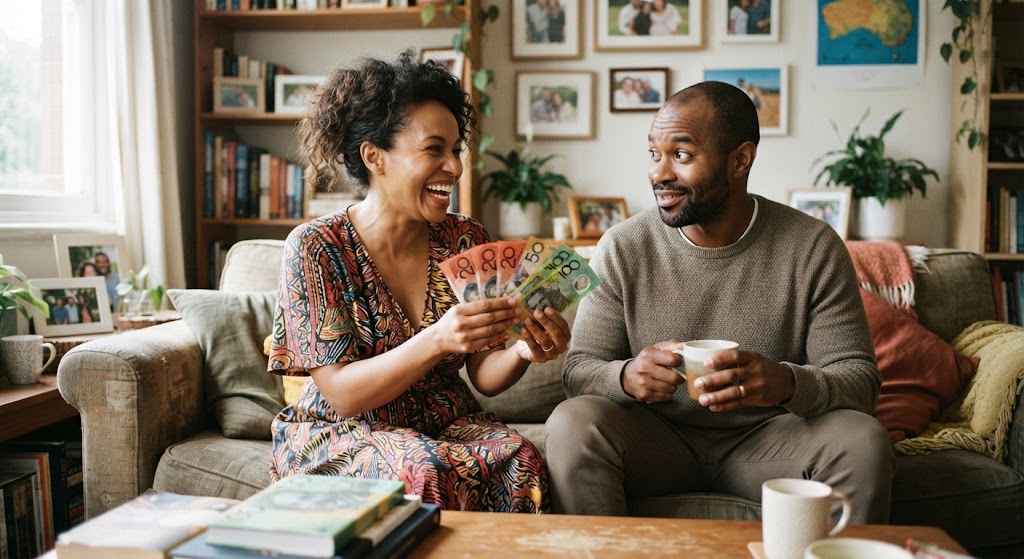
An African Australian-woman discussing financial matters with husband at home
Why Economic Independence Matters
I witnessed extreme cases that ended in divorce and family breakdown. These experiences reinforced a wider truth: economic independence is a vital part of freedom. Women’s work is often undervalued, especially when it involves caring for children, elders, relatives or community members. Migrant women may also encounter insecure employment, limited professional networks and the frustration of qualifications or experience not being recognised. When financial dependence is combined with cultural pressure, leaving an unsafe or controlling situation becomes much harder.
Many women depending on their cultural backgrounds have been limited to carrying for their domestic responsibilities. This reality has shifted. Domestic responsibilities must be shared as households can no longer sustain on one income. Therefore, more and more women from migrant backgrounds have had to challenge cultural norms and expectations by obtaining employment and advancing their careers to be able to fend for themselves and create a better life for their children should the marriage die or family separate.
Research continues to indicate that many women particularly middle age women become homeless following family breakdowns, because this is often the generations where women stayed home and as such, had no employment and therefore no super. When the relationship died, they are most at risk and vulnerable because not only did they not have an employment, they also did not have economic independence and security.
Education and Opportunity
Education can interrupt this cycle, but it means more than earning a certificate. It also includes financial literacy, mentoring, digital capability, knowledge of workplace rights and access to networks that open doors. African Australian women need visible leaders who share their heritage and understand their realities. They also need the freedom to imagine lives beyond the roles others have chosen for them.
There’s never been a more critical time such as now, where women need to have economic independence to build their future not depending on their spouse, but also security for a better life irrespective of what the future holds.
A Vision for a More Just Australia
Womanhood should never come at the cost of safety, opportunity or freedom. No woman should be expected to reduce her ambitions, carry invisible burdens without recognition or repeatedly prove her dignity and humanity before she can participate fully in society. A truly just Australia must recognise that women’s equality is not a privilege to be granted selectively, but a fundamental right that strengthens families, communities and the nation as a whole.
We must build an Australia in which every woman can live safely and free from violence, gain an education and achieve lasting economic security. Women must be represented wherever decisions affecting their lives are made—from households and community organisations to workplaces, public institutions and government. They must also have the freedom and confidence to speak, contribute and lead without discrimination, intimidation or pressure to remain silent.
