

By Clyde Sharady
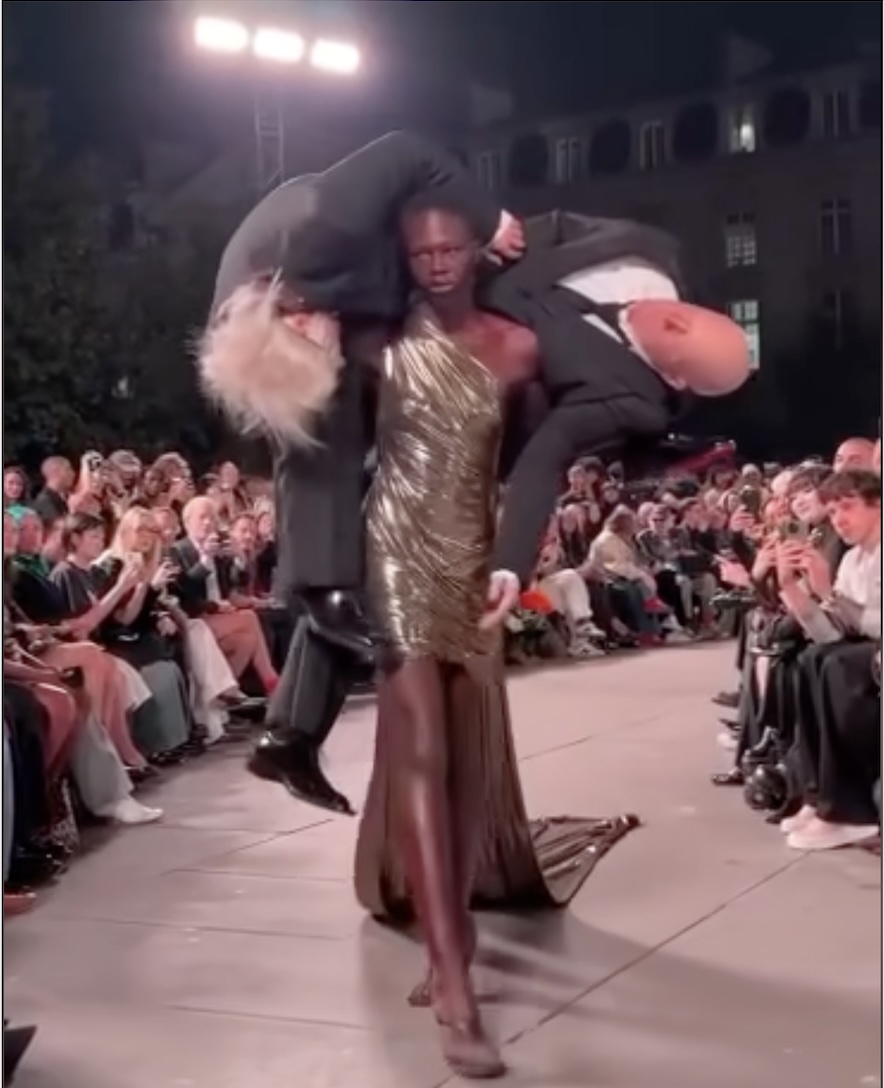
When South Sudanese model Abuk Yurr walked a fashion show runway draped in a metallic gold gown, carrying two men in black suits across her shoulders, the image spread like wildfire across social media. The pose was dramatic, visually striking, undeniably bold. Conversations erupted about the artistic vision, the symbolism, the statement being made.
But beneath the surface of this viral moment lies something far more complicated—something that demands we look beyond the aesthetics and into the deeper currents of history, race, and representation.
The Image and Its Layers
At first glance, the photograph reads as a display of power. A Black woman, regal in gold, bearing the weight of two grown men with apparent ease. The composition is deliberately provocative, designed to make us look, pause, and think. Fashion has always been a space for challenging norms, for pushing boundaries, for forcing uncomfortable conversations.
Yet art does not exist in a vacuum. It lands on soil already tilled by centuries of racialized imagery, cultural narratives, and lived experience. And when we consider what this particular image evokes, we cannot ignore the historical weight it carries—both
literally and figuratively.
The “Strong Black Woman” and Her Burdens
For generations, Black women have been cast into a singular, suffocating role: the one who endures. The one who provides. The one who protects, nurtures, and carries the burdens of everyone around her—often while being denied the basic permission to simply be human.
This archetype—the “Strong Black Woman”—did not emerge from nowhere. It was constructed and reinforced through slavery, segregation, and systemic marginalization. It told Black women that their value lay in their capacity to withstand pain, to sacrifice endlessly, to remain unshakeable no matter the cost.
So when an image emerges of a Black woman carrying two white men on her shoulders, it cannot help but resonate with that deeply familiar narrative. Regardless of the artist’s intention, the visual language speaks to something older, something painful, something many Black women know intimately.
The symbolism here invites many questions :
Why is it so often the Black woman who must demonstrate extraordinary strength to prove her worth?
Why must her body become the symbol of endurance, sacrifice, and resilience?
Why are we so comfortable celebrating Black women’s strength without ever asking what that strength costs them?
The “Strong Black Woman” trope is not a compliment. It is a cage. It tells Black women they must be strong even when exhausted, resilient even when hurting, capable of carrying everyone else even when they desperately need someone to carry them.
Black women are not beasts of burden.
They should not have to carry men to demonstrate power.
They should not have to carry families to demonstrate love.
They should not have to carry communities to demonstrate leadership.
They should not have to suffer in silence to demonstrate strength.
What if we ask what do black women really deserve? Where should we look to find answers to this question ?
Black women deserve softness. They deserve care. They deserve protection. They deserve rest. They deserve the freedom to be vulnerable without being seen as weak. They deserve to be carried, too.
The viral image of Abuk Yurr is stunning, no doubt. It is fashion, it is art, it is provocation. But it is also a mirror reflecting back a history that many would prefer to ignore. And when an image intersects with generations of racialized representations of Black women’s bodies and labor, it is not only reasonable but necessary to ask: What does this reinforce?
Why is it that Black women are so often expected to carry the world on their shoulders—and then praised for how much weight they can withstand?
Perhaps the most radical thing we can do is to stop applauding the weight and start asking why it was placed there in the first place.
Black women are more than what they can carry.
