

The debate over whether people of African descent living in other countries such as the United States or in Australia should be described as African-American, African-Australian or simply Black raises a deeper question: At what point does acknowledging someone’s ancestry become a way of reminding them that they are not entirely part of the society in which they live?
It is a question worth examining, particularly as Western societies become increasingly multicultural and generations of people of African descent are born, educated and raised in countries far removed from the African continent.
Condoleezza Rice and the politics of identity
Former US Secretary of State Condoleezza Rice has previously discussed her reservations about being described as African-American in media interviews. Her position is not simply about terminology; it reflects a particular understanding of American history and belonging. Her argument raises an important consideration: why should someone whose family has lived in America for generations continue to be identified primarily through an ancestral connection to another continent?
In the context of America Rice explained that she is uncomfortable with the term because it can suggest that Black Americans are immigrants, like Italian-Americans or Japanese-Americans. She argues that the history of African Americans is fundamentally different: their ancestors were brought to America through slavery, and their descendants helped build the country. They were not newcomers seeking acceptance into an existing society; they are an integral part of America’s history.
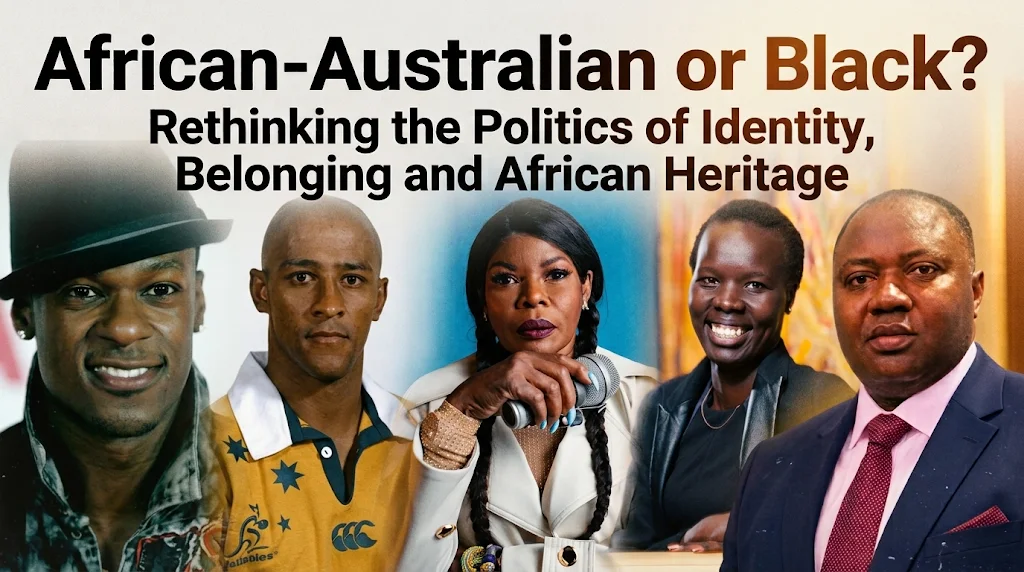
More Afro descendants live in Australia than ever before
Rice has also acknowledged the importance of recognising African heritage while questioning whether the term African-American adequately reflects the experiences of slavery, historical displacement and generations of cultural and social integration. Her preference for identifying as Black is therefore rooted in a broader debate about identity, ancestry and national belonging.
Is the African adjective a subtle form of exclusion?
There is a legitimate argument that labels such as African-American and African-Australian can sometimes reinforce the idea that people of African descent are perpetual outsiders.
Consider someone born in Melbourne, whose parents were born in Australia and whose grandparents may also have been Australian citizens. Why should that person automatically be described as African-Australian rather than Australian?
Would we routinely describe Australians of European ancestry as European-Australians, or Australians of British ancestry as British-Australians, regardless of how many generations their families have lived here?

The inconsistent application of these labels can create an impression that Australian identity is unquestioningly available to some people, while others must continually qualify their belonging through their ancestry.
Australian academic Melissa Phillips explored this problem in her 2011 paper, Convenient Labels, Inaccurate Representations. She criticised the blanket application of African-Australian to African migrants and refugees, arguing that it can homogenise people with very different national, cultural and personal experiences. Western Sydney University
The Australian Human Rights Commission has similarly recognised the need to avoid treating African Australians as a homogeneous population, emphasising the considerable diversity within these communities. Australian Human Rights Commission
There is also a danger that the African label becomes associated primarily with migration challenges, poverty, settlement difficulties, crime or disadvantage. This can unintentionally reinforce negative stereotypes rather than recognise the full contribution of people of African descent to Australian society.

But is there still a reason to retain the African identity?
Absolutely. Rejecting the automatic application of the African adjective should not mean abandoning it altogether.
For many people, African identity is a source of pride, belonging, cultural continuity and solidarity. It connects them to a continent with a rich history, diverse cultures, languages, traditions and civilisations.
For African migrants, particularly first-generation Australians, retaining the African identity can be an important way of maintaining connections with their countries of origin. For their children and grandchildren, it can provide a meaningful connection to their family histories and ancestral heritage.
There is also a political and social dimension. A collective African identity can provide a platform for communities from different countries to unite around shared interests, address discrimination, advocate for representation and build institutions.
In Australia, for example, the expression African-Australian has helped create a collective identity through which people of Congolese, Nigerian, Ethiopian, Sudanese, Ghanaian and other backgrounds can engage with governments and institutions.
Research by Abay Gebrekidan at La Trobe University found that some African migrants embraced the African-Australian identity as a unifying expression, while others preferred their specific national or ethnic identities. This demonstrates that the label can be meaningful without necessarily being universally accepted. afsaap.org.au
The important distinction is between an identity that people choose and one that society imposes on them.
Black is not necessarily a better universal alternative
Rice’s preference for Black also deserves consideration, but it does not resolve every problem.
Black is a broader racial identity that encompasses people with African ancestry as well as people of Caribbean, Afro-Latin American and other backgrounds.
It can be politically powerful because it recognises shared experiences of racial discrimination and exclusion. However, it can also overlook significant differences in history, culture, nationality and lived experience.
An African immigrant who arrived in Australia five years ago does not necessarily share the same cultural experiences as an Aboriginal Australian, an African-American whose ancestors experienced slavery, or a third-generation Australian of Nigerian descent.
A recent scholarly study examining identity preferences among Americans of African descent highlights these differences, including tensions between African immigrants and African Americans over how they understand and identify themselves. SPSSI+1
Consequently, neither Black nor African-Australian should become an automatic identity imposed on everyone.
Finding a balance: belonging without losing heritage
Perhaps the most useful approach is to stop treating national identity, racial identity and cultural heritage as competing concepts.
Someone can be Australian without qualification and still be proudly African by ancestry, culture or heritage. Equally, someone can identify as Black without necessarily identifying as African-Australian.
We should also recognise that identities evolve across generations. The children and grandchildren of African migrants should have the freedom to define themselves without being permanently assigned an immigrant identity.
For media organisations, governments and community institutions, this means being more thoughtful about terminology. Where possible, specific national or cultural identities should be used. Collective descriptions should be retained when they serve a legitimate purpose, particularly in community representation, research and advocacy.
The real question for Afro descendants is: who has the right to define our communities?
Ultimately, the problem is not necessarily the word African, African-American or African-Australian. It is the assumption that other people have the right to determine how individuals should identify themselves.
There is considerable merit in retaining African as an expression of heritage, solidarity and cultural pride. But there is equally considerable merit in challenging its use when it becomes a permanent reminder that people of African descent are somehow different from, or less entitled to belong to, the societies in which they live.
Being African should not make someone less Australian or less American. Equally, being Australian or American should not require someone to abandon their African heritage.
Perhaps the most appropriate position is this: let people embrace their African roots without having their national belonging questioned, and let those who prefer simply to be called Australian, American or Black do so without having to justify their choice.
Identity should be a matter of personal dignity and self-determination, not an administrative label or a social boundary.
Clyde Sharady | Editor
