

A renewed push to reform Australia’s skilled migration pathways recently gathered momentum as community leaders met with Assistant Minister for Immigration and Assistant Minister for Foreign Affairs and Trade, Matt Thistlethwaite, at a roundtable convened by the Department of Home Affairs. Among those at the table was the leadership of Kenyans in Queensland Inc. (KIQ), represented by President Antony Kamau, carrying a message shaped by months of consultation within the Kenyan diaspora across South East Queensland.
The meeting comes at a pivotal moment for Queensland. With Brisbane preparing to host the 2032 Olympic and Paralympic Games, the state is bracing for sustained demand across infrastructure, engineering, health, ICT, education and hospitality. The question raised by community advocates is straightforward: why struggle to fill workforce gaps when highly skilled migrants already living in Australia are ready and willing to contribute?
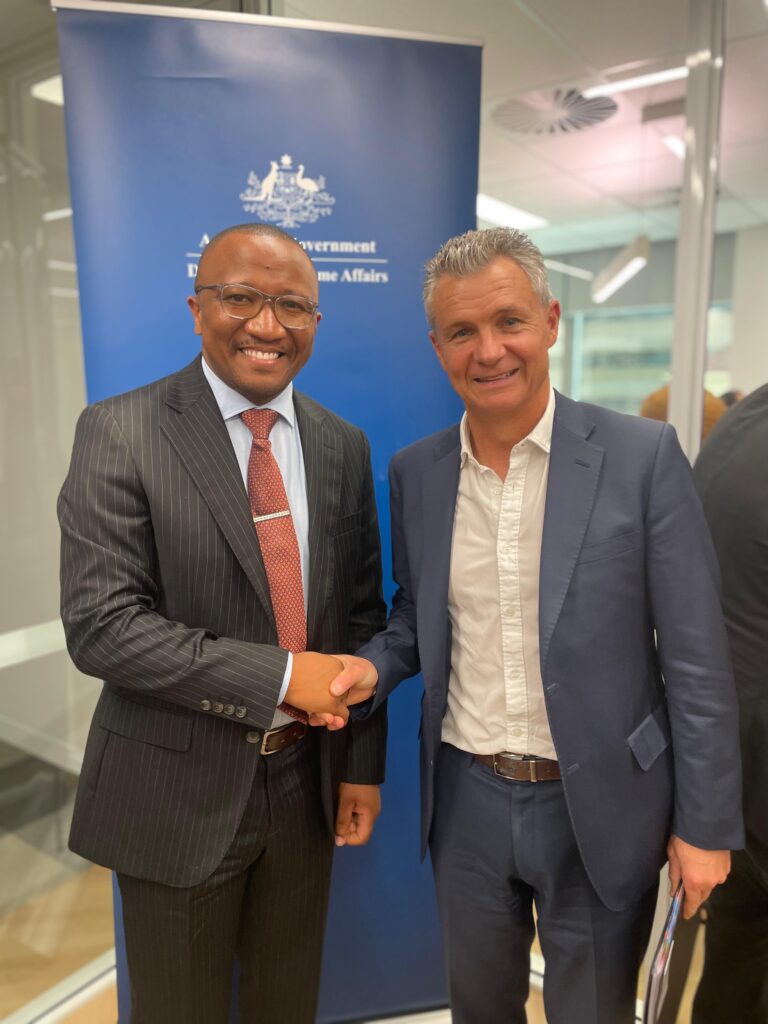
Anthony Kamau (Left) and Matt Thistlethwaite (right)
According to the most recent Census, more than 22,000 Kenya-born residents live in Australia, including over 3,400 in Queensland. The community is highly educated and largely English-speaking, with many working across business, information technology, healthcare, research and small enterprise. A significant number are Australian citizens, while others remain on temporary or transitional visas, navigating complex pathways toward permanency.
Yet despite their qualifications, many encounter structural barriers that slow or stall their professional integration. Overseas credentials can take months, sometimes years, to be recognised. Skills assessments often duplicate documentation already verified elsewhere. Employers frequently cite a lack of “local experience” as a reason for rejecting capable candidates. Visa processing delays add further uncertainty, making it difficult for both migrants and employers to plan. Even English proficiency requirements can feel redundant to those educated entirely in English-medium systems or trained in Australian institutions.
Community representatives at the roundtable argued that these inefficiencies come at a cost not only to migrants, but to the broader economy. When engineers drive rideshare vehicles while waiting for paperwork or Australian-trained graduates struggle to transition into skilled roles, Australia loses productivity. At a time when government policy aims to link migration more directly to workforce needs, faster utilisation of existing talent is a practical solution.
KIQ has already taken steps at the grassroots level. Its annual Students and Professionals Summit connects migrants with employers and industry leaders. Informal mentorship networks guide new arrivals through career pathways. Partnerships with universities help international students transition into employment, and collaboration with organisations such as African Professionals of Australia strengthens professional integration. Community members are also encouraging local businesses to offer internships and placements to create entry points into the labour market.
But community initiative alone cannot replace policy reform. Advocates are calling for streamlined recognition of overseas qualifications, clearer and more predictable visa processing timelines, more flexible approaches to demonstrating English proficiency, and stronger bridges from study to skilled employment. They also propose closer collaboration between government, employers, universities and community organisations to align migration settings with Queensland’s long-term workforce strategy.
The urgency of these reforms is underscored by recent geopolitical tensions affecting the Democratic Republic of Congo and broader African migration narratives, but the focus at the roundtable remained firmly domestic: how to ensure that skilled migrants already present in Australia can contribute fully and without unnecessary delay.
The establishment of a joint steering committee between Australia and key partners signals that migration policy remains central to national economic planning. Yet community leaders emphasise that real success will depend on transparent dialogue and continued engagement at the local level.
For many in South East Queensland’s Kenyan community, the issue is not about special treatment but about fairness and efficiency. The talent is here. The demand is growing. The opportunity is historic. As Brisbane moves toward 2032, unlocking the full potential of skilled migrants may prove to be one of the most practical steps the state can take to secure its economic future.
