

The civil rights icon Reverend Jesse Jackson passed away peacefully on Tuesday, February 17, surrounded by his family after a long battle with Parkinson’s disease, his family announced on Instagram. “A tireless advocate for change, he gave a voice to the voiceless… leaving an indelible mark on history,” the statement read.
Born into a segregated America, Jackson became one of the most prominent figures in the struggle for racial equality in the United States. He was by Martin Luther King Jr.’s side in Memphis in 1968 when the legendary civil rights leader was assassinated. Decades later, he stood silently among the crowd celebrating Barack Obama’s historic election in 2008, and he supported the family of George Floyd in 2021 following the conviction of former police officer Derek Chauvin.
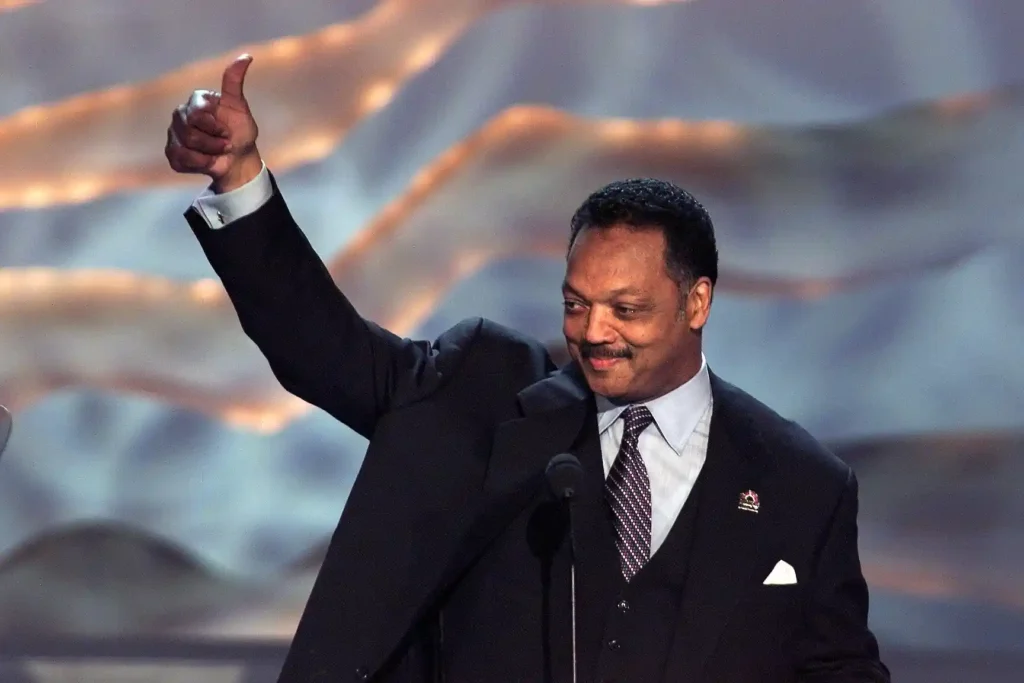
Revered Jesse Jackson, civil rights leader
“My constituency is the desperate, the downtrodden, the disenfranchised, the disrespected, the despised,” Jackson declared during the 1984 Democratic National Convention, a statement that reflected his lifelong commitment to marginalized communities.
Jackson’s career began in the 1960s with the Southern Christian Leadership Conference, where he worked under Martin Luther King Jr. to promote nonviolent civil rights activism. He later founded his own organizations, including Operation PUSH, now known as Push Rainbow, which continues to champion minority rights, particularly voting rights, while also providing financial support for disadvantaged Black families and funding education for thousands of children.

His journey was not without controversy. In 1984, Jackson drew criticism for using an anti-Semitic term in reference to New York, and in 2005, he publicly supported Michael Jackson during the pop star’s sexual abuse trial.
Jackson’s national prominence grew with his two presidential campaigns, in 1984 and 1988, expanding the Democratic Party’s platform to address African-American issues. In 1988, he delivered a memorable speech calling for national unity: “Left wing, right wing… it takes both wings to fly.”
Known for his sharp critique of economic inequality, Jackson often described the system as a “reverse Robin Hood,” one that enriched the wealthy while leaving the poor behind. His dedication to justice, equality, and empowerment has left a lasting legacy that continues to inspire generations.
