

The recent U.S. military strike in Venezuela and the capture of President Nicolás Maduro has sent shockwaves far beyond Latin America. It is not only the scale of the operation that has unsettled the international community, but the precedent it sets: a sitting head of state apprehended by a foreign power through direct military action.
Across the world, political leaders are deeply divided. Some have openly praised former U.S. President Donald Trump’s decision, arguing that it signals the end of tolerance for regimes accused of criminality, repression, and destabilisation. Others have strongly criticised the action, describing it as a violation of international law and a dangerous assault on the global order built on sovereignty and multilateralism. This division reflects a growing fracture in global politics and highlights how fragile international norms have become.
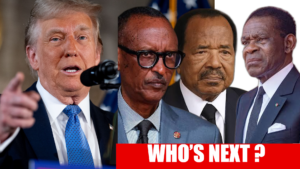
Beyond Venezuela, the message is global. For decades, authoritarian leaders have governed under the assumption that state sovereignty guarantees protection. Sanctions could be imposed and condemnations issued, but personal consequences were rare. The events in Venezuela challenge that assumption and suggest that, under certain conditions, powerful states may act unilaterally when diplomacy fails.
For Africa’s authoritarian leaders, this moment carries particular significance. Across the continent, several long-serving leaders continue to suppress political opposition, manipulate elections, and extend their rule under the banner of stability. Many have relied on strategic alliances with Western powers, believing these relationships offer lasting protection. The situation in Venezuela raises a critical question: what happens when international patience runs out?
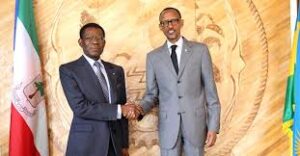
President Obian Ngema (left) and Paul Kagame (right)
One of the most relevant cases is President Paul Kagame of Rwanda. For years, Kagame has been regarded as a key regional ally and a symbol of post-conflict recovery. However, Rwanda’s alleged involvement in the conflict in eastern Democratic Republic of Congo has increasingly put that reputation under strain. Despite repeated diplomatic efforts, violence in the region has persisted, undermining peace and stability.
In 2025, Rwanda and the DRC signed a U.S.-brokered agreement in Washington aimed at de-escalating tensions and restoring peace in eastern Congo. The agreement was meant to signal a new chapter in regional cooperation and carried strong diplomatic expectations. Yet continued fighting and accusations of violations have cast doubt on Rwanda’s commitment to the deal. The Trump administration had already made it clear that agreements signed under U.S. sponsorship were not symbolic gestures but binding commitments.
The relevance of Trump’s approach cannot be ignored. His foreign policy was defined by a willingness to use pressure, including military force, to achieve strategic objectives. He repeatedly stated that the United States would act in different parts of the world if it believed its interests or global security were threatened. The capture of Maduro, applauded by some and condemned by others, aligns with that worldview and reinforces a message of uncompromising power.
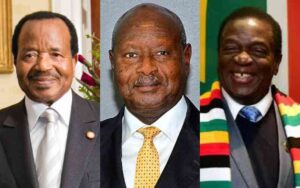
Paul Biya, Yoweri Museveni and Emerson Mnagwagwa
For African dictators, this should serve as a warning. The international environment is shifting rapidly. Leaders who once felt shielded by alliances or geopolitical usefulness may find themselves exposed when global priorities change. Yesterday’s partner can quickly become today’s problem.
This is not to suggest that African leaders are about to face military intervention. Rather, it signals the gradual erosion of impunity. The tolerance for leaders who violate peace agreements, destabilise neighbouring countries, or rule indefinitely through repression is diminishing.
Maduro’s capture has divided the world, but it has also clarified an uncomfortable reality: sovereignty without legitimacy is increasingly fragile. African leaders still have a choice. They can respect constitutions, honour international agreements, and prioritise peace and accountability. Or they can continue down a path that risks isolation and consequences in a world where power is becoming more assertive and less forgiving.
The lesson is simple. In a changing global order, authority without legitimacy is no longer guaranteed protection.
Nyembo Sharady
