

Traoré Points to Security Gains and Economic Ambitions in Burkina Faso’s Year-End Address
Ouagadougou — Burkina Faso’s transitional leader, Captain Ibrahim Traoré, used his end-of-year address on 31 December to project confidence in the country’s security trajectory and economic direction, outlining what his government views as tangible progress in 2025 and setting priorities for the year ahead.
Addressing the nation, Traoré placed strong emphasis on recent military operations aimed at reclaiming territory from armed groups. He cited expanded offensives carried out under a national security campaign that, according to authorities, enabled government forces to reassert control over several localities previously beyond state authority. Areas in eastern and northern Burkina Faso were highlighted as among those seeing renewed military presence.
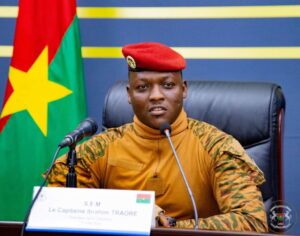
Captain Ibrahim Traore: president of Burkina Faso addressing the nation
Traoré credited both the national armed forces and civilian defence auxiliaries for their role in stabilisation efforts, stating that operations would continue toward border regions as part of a broader push to secure the country’s territorial integrity.
Beyond security, the president pointed to what he described as encouraging humanitarian developments. He reported that displaced populations have begun returning to areas deemed secure, with support provided to restart farming activities and rebuild essential services. These returns, he said, signal early steps toward restoring normal life in affected communities.

Economic self-reliance featured prominently in the address, particularly in the agricultural sector. Traoré announced that Burkina Faso reached food self-sufficiency in 2025, attributing the outcome to expanded cultivation, improved access to inputs, mechanisation initiatives and state-backed subsidies. Plans for 2026 include additional irrigation projects, water storage infrastructure, livestock feed production and aquaculture development.
The president also outlined ongoing reforms in mining, education and health, including efforts to strengthen state oversight of natural resources, expand vocational and technical training, and improve healthcare infrastructure. Infrastructure development, particularly road construction and urban planning, was identified as another priority area.
On foreign relations, Traoré reaffirmed Burkina Faso’s pursuit of an independent policy, stressing cooperation with international partners willing to engage on the basis of mutual respect and national sovereignty.
Concluding his address, he called on citizens to embrace values of integrity, discipline and patriotism, framing the coming year as a continuation of efforts to reshape Burkina Faso’s political, economic and social foundations.
